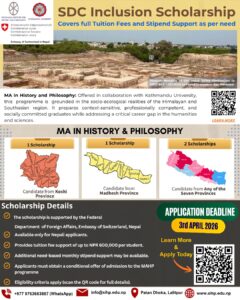
MA in
History and Philosophy
(Society, Technology and Environment)
Photo Credit: Yalamber Tamot
Source: Cāruvatī Thūpa: Kirat period inscription from Nepalmandala
The MA in History and Philosophy is a 60-credit programme conducted in collaboration with Kathmandu University, providing curricula tailored to Himalayan and Southasian socio-ecological realities and aspirations, to prepare context-sensitive, professionally competent and socially committed graduates, and to help close an important ‘career gap’ in our societies.
The three thematic streams, viz., History and Philosophy of Society, Technology and Environment will, among other things, help bring about qualitative improvement in future undergraduate and high school education in the humanities and sciences in Southasia—defined as a demo-biogeographic region.
The course is for you
- If you are looking for meaningful academic and community engagements, and creative immersion in transforming material and non-material conditions in society and nature around you through sound historical and philosophical approaches;
- If you want to enhance your critical understanding of why Southasian populations and communities have evolved their diverse forms of social, political and economic characteristics;
- If you want to experiment with and learn about collective strategies, actions and solutions to pathways towards dignified lives and livelihoods of our populations;
- If you believe that only by corresponding with dynamics of the earth systems, such as those imposed by the oceans, the Himalaya, or the monsoon can societies in Southasia remain sustainable, accessible, egalitarian and equitable;
- If you believe strongly in the emancipatory purpose of higher education in which learning outcomes assist us to help others in realising their personal and collective liberation, and dismantle newer forms of barriers, bondage and suffering arising through cultural and economic distinctions.
Values of the MA Programme
SiHP’s MA Programme actively encourages its students, through diverse and open-ended enquiries and continuing experimentation, to gain the following four central values:
1. Value of Transformative Experience
Education is meant to be more uplifting than acquiring knowledge, a set of skills and employment. The MAHP programme seeks to encourage its students in findings ways to enrich and transform themselves through their experience about the world.
2. Value of Inter-connectedness
Since the world is a total set of relations, the Programme promotes enquiries that capture this inter-connectedness along with their full dynamic complexity.
3. Value of Authenticity
ntuitive understanding and self-awareness such that the students are able to articulate and act with authenticity to bring effective transformation in their world.
4. Value of Detachment
The MAHP programme aims to enhance the students’ appreciation of the value of detachment from self, and the self as a space of possibilities for better individuals as well as collective action and realisation.
Goals of the MA Programme
1. Deep Engagement with ‘Texts’
The Programme helps its students to tackle a set of activities centred on ‘texts’, as broadly defined, namely –
- extract problem, data, information, solution, argument and its structure;
- engage with the original and supplementary ideas constructively for complexity and contradiction;
- develop appropriate (linguistic, digital and comparative) skills to approach and interpret the texts as well as search emphatical ways to improve the clarity of the questions or robustness of solutions by would-speculations;
- comprehend the context of production, dissemination and use of the texts by posing What-If scenarios, finding new questions and research directions;
- outline the historical development of related ideas, approaches and methods, and master the range and scale of texts for shifting interpretation.
2. Conceptual Maturity
The Programme encourages its students to develop intuitive and original understandings through the following activities –
- acquire understanding of existing themes, theories, practices and interpretations;
- have conceptual means to distinguish what makes a question historical/philosophical;
- identify appropriate historical/philosophical responses to the questions asked;
- achieve historical/philosophical maturity in grasping a pluralist/diversity-sensitive approach to different schools and thinkers;
- further the fields of Southasian history and philosophy, and the three thematic areas of the course.
3. Quality Research
Through research assignments and the mandatory thesis, students in the Programme are supported to –
- demonstrate proficiency on topics related to Southasia and those relevant to the lives and livelihood of its inhabitants;
- perform research skills on a chosen question in history and philosophy of society, technology and environment;
- make contributions to the discipline by reformulation of a question, redesign/repurpose a method, or finding a novel solution;
- exhibit presentation, engagement and persuasion skills;
- practice a sensitive and responsive, discipline-specific and field-appropriate conduct of research.
4. Professional Skilling
The students enrolled in the Programme will gain the following professional skills under expert guidance –
- writing skills (mss, proposals, reports), teaching skills (to a group and to another person), oral presentation skills, coordination, collaboration and mentoring skills;
- skills related to time management, teamwork and leadership;
- research management and administration skills including constructive feedback, effective communication, data and resource management;
- linguistic and design skills for public engagement of research methodologies and findings.
Eligibility
- A score of at least 50% in aggregate or CGPA 2.0 out of 4.0 grading system in any undergraduate discipline from a recognised institution; or
- Exceptional, demonstrable and proven capacity to contribute to transforming Southasian societies or for rare recommendation of being as equivalent as above.
- An acceptable ranking in SiHP’s ALT-HuS (Advanced Level Test for Humanities in Southasia) admission exam.
General Details
Total Seats: 22
Duration: Two Years(4 Semesters) OR
Part-time: Three Years(6 Semesters)
Class Hours: 11 am – 5am (Mon- Fri)
Rolling Admission: You can apply, be evaluated and get accepted anytime throughout the year!
Conditional Offer: Available for applications who are still completing their requirements. You can secure your spot while finishing up your ongoing course.
Scholarship Schemes
| a. Merit (upto 80% of the total fees) | Awarded for outstanding performance in SiHP’s ALT-HuS exam. Recognises top achievers and encourages continued excellence. |
| b. Inclusive (upto 50% of the total fees) | Supports students from under-represented or disadvantaged backgrounds. Promotes equal access and diversity in education and in the classrooms. |
| c. Graded scholarships (partial to full tuition fees) | Offers partial to full tuition waivers depending on performance in each semester. |
| d. Chair Fellows | Prestigious grant that supports advanced research and specialisation for students. |
| e. Director’s List | Granted to students with exemplary academic records and conduct during their studies at SiHP. Recognises those on the Director’s List. |
| f. History & Philosophy Subject Scholarship | Granted to students with exemplary performance in History or Philosophy. |
| g. Stipend | Provided in exchange for academic or administrative work such as research assistance, teaching support, departmental duties, or for specific assignments. |
| h. Hardship Fund | Discretionary financial aid intended to support students facing unexpected financial hardship, such as medical emergencies, family crises, or other serious personal challenges, particularly in their thesis semester. |
| i. Support for External Grants/Scholarships | SiHP provides active administrative support for prospective and current students to procure grants, scholarships and loans from external institutions in our network, also extending early conditional offers, recommendations and communications. |
Curriculum
The MA curriculum includes foundational and advanced courses in History and Philosophy, and elective courses in Society, Technology and Environment. The MA Programme curricula is based on five principles –
- strong and guided expertise in historical and philosophical explorations
- creative comprehension and articulation skills
- committed community engagement
- academic freedom and periodic audits
- continual assessment and task-based interactional pedagogy
The thematically structured curriculum enables faculty, students and experts, from Southasia or beyond, to grasp, share and articulate the course content. Classical and Other language learning as well as strong fieldwork and community engagement requirements equips students with skills to break ideological and epistemic barriers existing in the mainstream humanities and arts curricula in the region.
Language
Contemporary Language:
In the first semester, students will take a course in one of the living languages other than their mother tongue. If a student’s mother tongue is Tibeto-Burman, for instance, they will learn an Austro-Asiatic or Indo-European language; if coming from a dominant language group, they will take up a ‘minority’ tongue, preferably an endangered language. Achieving relative proficiency in a language not their own, students will glean first-hand insights into a broader and dynamic socio-linguistic, historical context within which historical and philosophical concepts are questioned and newer questions framed.
Classical Language:
In the second semester, it will be mandatory for students to acquire proficiency in one of the following ‘classical’ languages in Southasia, for example: Pali/Prakrit, Sanskrit, Tibetan, Limbu, Maithili or Tamil. This will deepen their appreciation of the enduring and echoing knowledge systems within which both urgent and emergent worldviews are debated, contested and resolved.
Fieldwork & Labs
The History and Philosophy Labs will help the SiHP academic community to formulate, test, incubate and extend practical, historically grounded and meaningful life-changing approaches to action for improving social, technological and environmental landscapes of the region.
This experimentation module brings concrete situations of History and Philosophy to the fore, thereby helping students gain practical insights into doing history and philosophy. The nature and aims of the actual experiments are customized to reflect changing interests and priorities of the students and reflecting requirements of Southasian populations and communities.
Three weeks in the field (i.e. outside campus) will help course participants to learn, engage and formulate historical/philosophical questions for the people and communities, questions that are critical, right and just.
Course Structure
SEMESTER I
(Core Course)
| Subject Code | Course Name |
|---|---|
| HPFH 501 | Foundations of History (3 Credit) |
| HPHT 502 | History and Taxonomy (3 Credit) |
| HPFP 503 | Foundations of Philosophy (3 Credit) |
| HPOL 504 | Other Languages (3 Credit) |
| HPLB 505 | History and Philosophy Ideas Lab (3 Credit) |
SEMESTER III (Elective Course)
Society
| Subject Code | Course Name |
|---|---|
| HHPS 601 | Private and Public Spheres (3 Credit) |
| HPEN 602 | Economic Processes and Networks (3 Credit) |
| HPPN 603 | Ideals and Norms (3 Credit) |
| HPIN 604 | Power Pathways (3 Credit) |
| HPFW 605 | Fieldwork 1 (3 Credit) |
SEMESTER III (Elective Course)
Environment
| Subject Code | Course Name |
|---|---|
| HPAS 611 | Atmospheric Studies (3 Credit) |
| HPHC 612 | Water Cycles (3 Credit) |
| HPLC 613 | Life and Its Conditions (3 Credit) |
| HPES 614 | Earth Systems (3 Credit) |
| HPFW 615 | Fieldwork 3 (3 Credit) |
SEMESTER II
(Core Course)
| Subject Code | Course Name |
|---|---|
| HPAH 506 | Advanced History (3 Credit) |
| HPPT 507 | Philosophy and Taxonomy (3 Credit) |
| HPAP 508 | Advanced Philosophy (3 Credit) |
| HPCL 509 | Classical Language (3 Credit) |
| HPLB 510 | History and Philosophy Innovation Lab (3 Credit) |
SEMESTER III (Elective Course)
Technology
| Subject Code | Course Name |
|---|---|
| HPPN 606 | Production (3 Credit) |
| HPIN 607 | Infrastructures (3 Credit) |
| HPII 608 | Information Interfaces (3 Credit) |
| HPCA 609 | Control and Access (3 Credit) |
| HPFW 610 | Fieldwork 2 (3 Credit) |
SEMESTER IV
(Core Course)
| Subject Code | Course Name |
|---|---|
| HPRW 616 | Research Writing (3 Credit) |
| HPRP 617 | Research Practice (3 Credit) |
| HPMT 618 | Thesis (9 Credit) |
Evaluation
Student evaluation is based on in-semester and end-semester examinations, classwork and homework assignments, lab, fieldwork and presentations, term papers, and, when applicable, publications. Faculty are continually assessed for their performance and effectiveness in course content delivery. Course details are periodically reviewed as well as audited, and the faculty are helped to construct the courses as required.
| Grade letter | Grade point | Marks | Qualitative meaning |
|---|---|---|---|
| A | 4.00 | 85-100 | Outstanding |
| A- | 3.70 | 80-84.9 | Excellent |
| B+ | 3.33 | 75-79.9 | Very good |
| B | 3.00 | 70-74.9 | Good |
| B- | 2.67 | 65-69.9 | Satisfactory |
| C+ | 2.33 | 60-64.9 | Fair |
| C | 2.00 | 50-59.9 | Poor |
| F | 0.00 | <50 | Fail |
Career Prospects
As a New Humanities Scholar, you will be able to perform various jobs and research activities as:
- Historian
- Philosopher
- Researcher
- Public Intellectual
- Policy Analyst
- Planner
- Diplomat
- Public Servant
- Journalist
- Art and Literary Critique
- Social Commentator
- Public Communicator
- Community Leader
- Academic
- I/NGO Project Specialist
- Social Activist
Student Support Services
We invest time and resources in providing personalised student services including counselling, co-learning, mentoring, guiding and referencing on one-to-one basis. Each individual at the time of admissions will be assigned a faculty supervisor who will mentor him/her for academic growth at SiHP, provide for individual counselling and guidance, as well as ensure co-learning with a peer group within the class and beyond.
SiHP also has career and student support counselling. The former has been designed to help students for in-study jobs, internships, trainings and skill enhancement, while the latter is a sign-up professional assistance to the students to ensure that the students’ time at SiHP is stress-free, enjoyable, rejuvenating and meaningful.
For more information/consultation:
info@sihp.edu.np
+977 9763683887 (WhatsApp)
Rolling Admissions Open
We welcome applications year-round, especially from those who want to start for Spring and Autumn intakes for the year 2026, 2027 and 2028.